
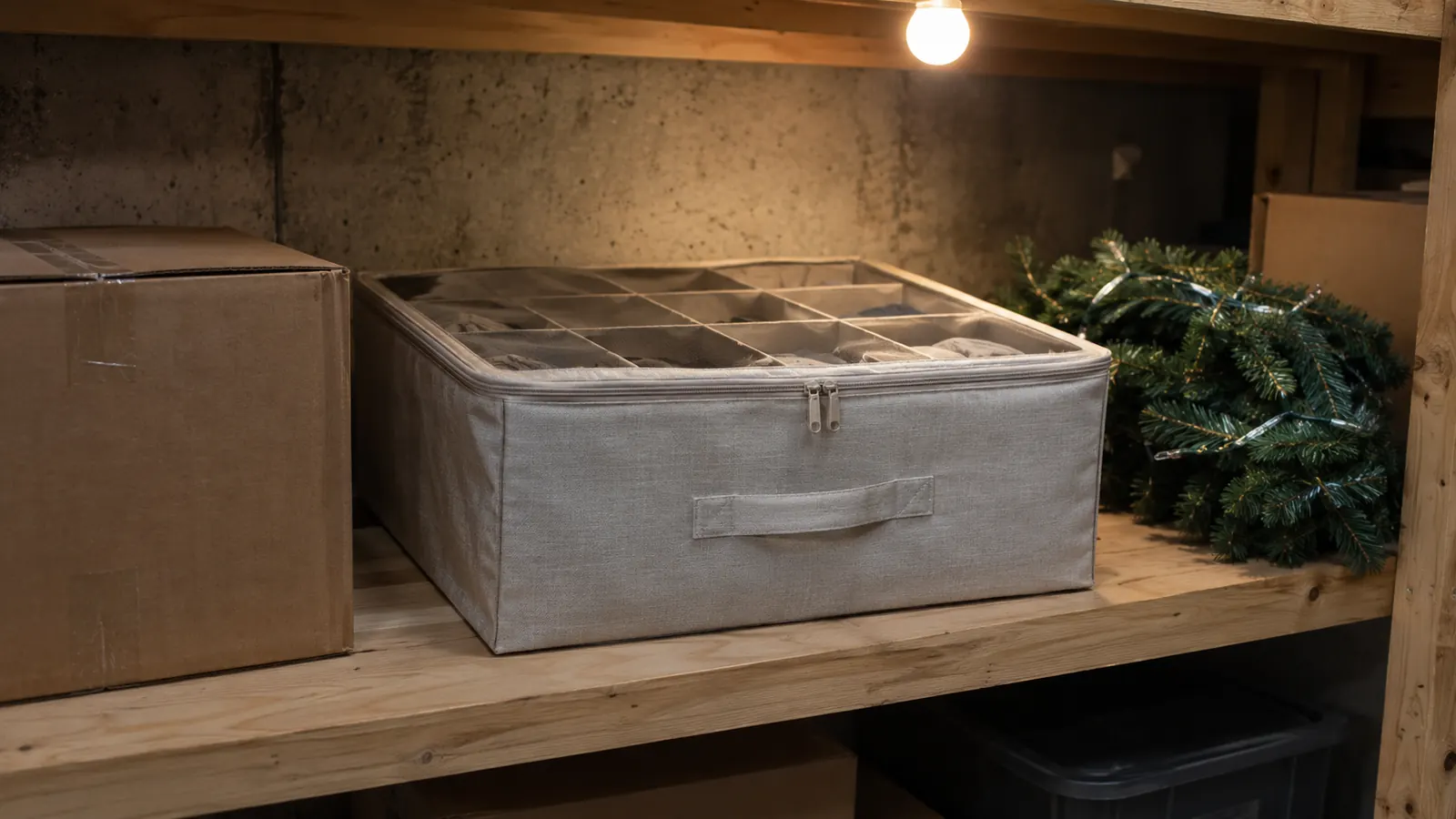
Every January I used to carry a cardboard box down to the basement, wedge it onto a shelf next to the fall decorations, and hope. Newspaper between the ornaments, lid folded shut, done. Then the weekend after Thanksgiving I would bring it back up and find one or two casualties. Not a disaster, just a hairline crack through the paint on a ball, or a little metal cap snapped off something I had owned since we moved into this brick house in Zanesville, Ohio, twenty-four years ago.
That is the part nobody tells you about a basement. It is not a closet with a door on it. Down there the concrete sweats in July, the air sits still, and a shelf that looks like a perfectly good spot in January is holding a box that gets shifted four times before December. Gary hauls the tree up the stairs and I do everything else, and for years the ornaments were the weak link in the whole operation. Last January I bought one ZOBER ornament storage box, the 24 by 12 by 12 size with 54 slots and dividers, and I put it through one full pack-away and one full unpacking. Nothing broke. That is the entire endorsement and it is enough for me. Here is the order I do it in now, because the order turns out to matter more than the box.
The 54-slot box that ended my January cardboard routine
A fabric ornament box with a divided grid, a zipper closure, and a card slot on the front so next December you know what is inside before you open it.
Amazon See Today's Price on Amazon →Step 1: Empty everything onto a table and sort before you buy anything
Do this on the dining room table with a bath towel under everything, not on the basement floor. I learned that one the hard way, at sixty-two, with a knee that does not appreciate kneeling on concrete for an hour. Bring the old boxes up one at a time, open them, and set every ornament down on the towel so you are looking at the whole collection at once instead of a jumble you keep re-digging through.
Then make three piles. Keep is the ornaments that actually go on the tree. Give is for my daughter and son when they visit, because their childhood ornaments belong to them and they can haul them to their own houses. Toss is anything already cracked, anything with a snapped hanger, and anything I held onto for years out of pure guilt and never once hung. Be honest with that last pile. A cracked ball is not going to heal on a shelf, and it takes up a slot that a good ornament could be using.
Count what is left before you buy a single container. Buying the box first and then discovering you have ninety ornaments is how a person ends up with two half-full containers and no shelf space. My keep pile came out at about fifty ornaments, most of them round balls around three inches across. The ZOBER box is divided into 54 slots and those three-inch balls drop in without forcing. Anything noticeably bigger than that is a separate question, and all I can honestly tell you is what my own collection did.
When I finally did the count that first January, I found eleven ornaments I could not have told you I owned: three balls still sealed in their package from a grab bag, a wooden snowman missing his hat, and a small set of bells I hung exactly once and never again. Those went straight to the give pile. The count also told me something useful, which is that my old cardboard boxes had been carrying closer to seventy pieces than fifty. No wonder a couple of them cracked every year. They had been stacked on each other in a box that was never sized for the job.
Step 2: Wrap the fragile ones before they ever touch a divider
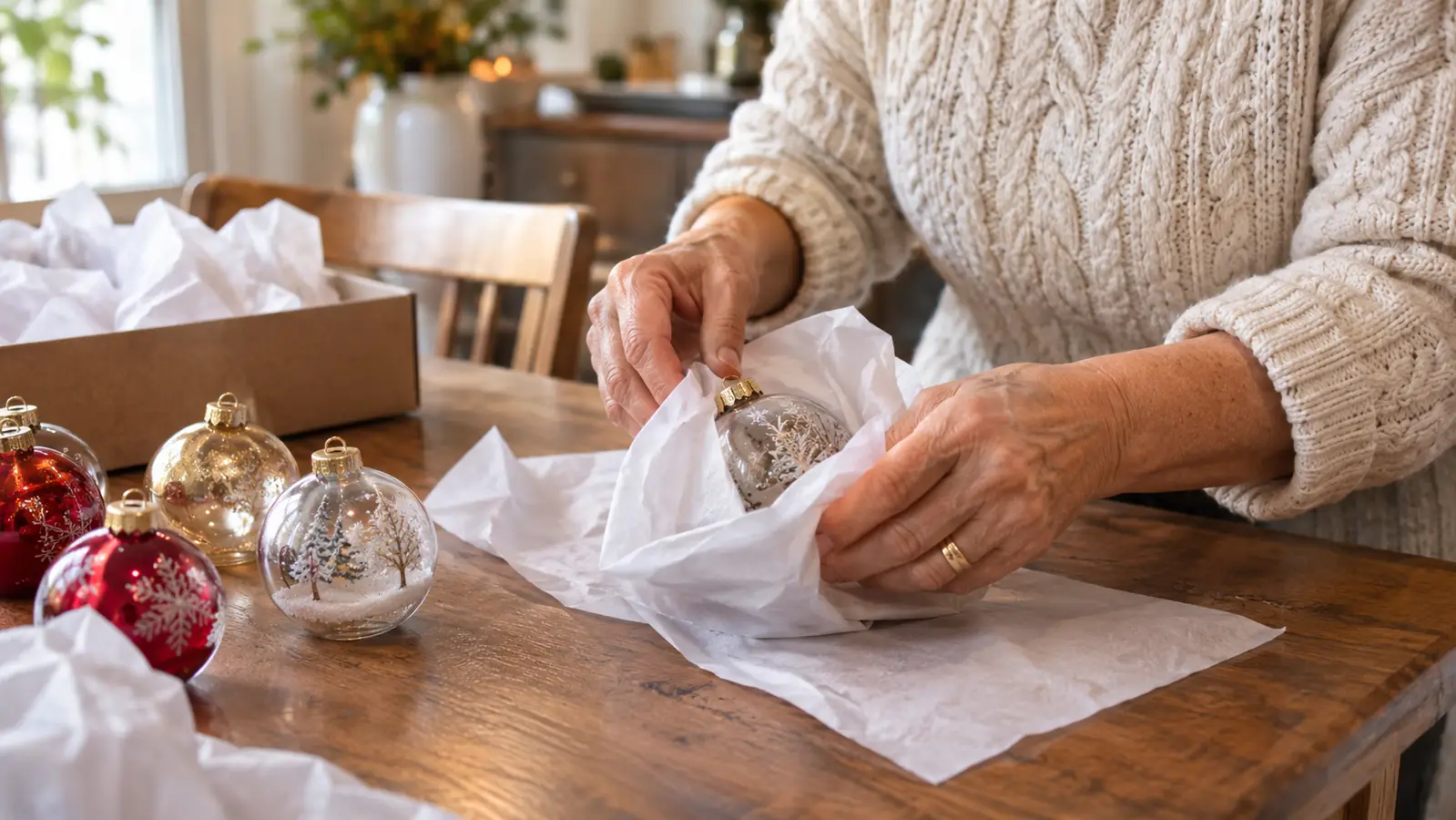
The dividers keep ornaments from knocking into each other. What they will not do is stop a painted surface from rubbing against the side of its slot, and that rubbing happens for eleven months straight on a shelf that gets bumped every time somebody reaches past it for the fall decorations. So the ones that need wrapping get wrapped, and the sturdy ones go in bare.
I use plain white tissue paper, the kind that comes folded in a package. Newspaper is what I used for twenty years and I am here to tell you the ink comes off on the paint. It also goes limp in a damp basement and leaves grey smudges on everything it touches. Tissue does not do either one.
I tried the alternatives first, so you do not have to. Bubble wrap works well enough, but it holds its shape, it pushes back against the divider, and by the second season the seams split and you are picking bits of plastic out of the box. Paper towels are too thin and tear on the hanger cap. A square of tissue folded corner to corner and tucked underneath takes about four seconds, comes off clean in December, and after a full season in my basement the sheets were still dry to the touch. That last part is the test that matters. If the paper comes out soft, your basement is telling you something and the ornaments need a higher shelf.
What gets wrapped in my house: anything handmade, anything with glitter or flocking, anything with a delicate hanger cap, and the glass balls that came from my mother. What goes in bare: the wooden ones, the fabric ones, the metal ones, and the plastic ones that could fall off the roof and survive the trip. When I am on the fence, I wrap. A sheet of tissue takes four seconds and it is the cheapest insurance in the whole basement.
Step 3: Load the box from the bottom row up, heaviest first
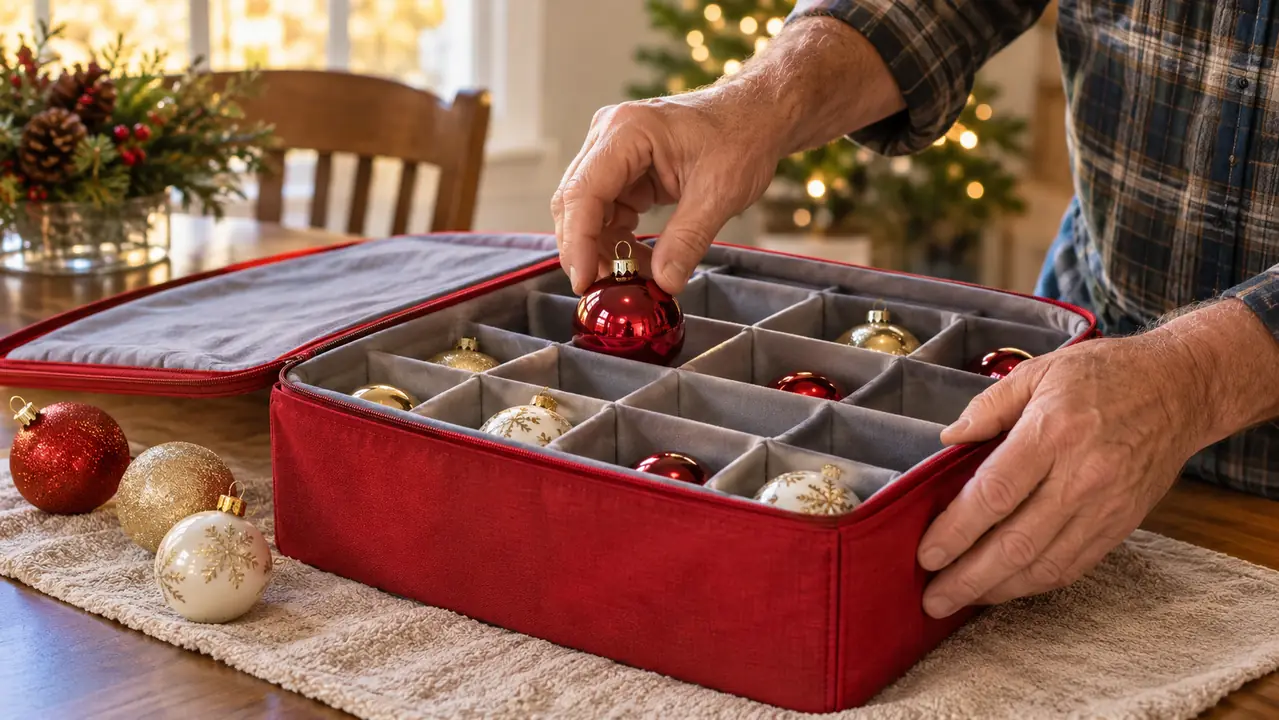
The box measures 24 inches long, 12 wide and 12 tall, and the dividers form a grid inside it. Fill the bottom row first and work your way up. Heavier ornaments and the biggest ones go low, so the box sits settled on the shelf and does not tip forward at you when you pull it out by the zipper.
Group them in a way you will still remember in November. I sort by where they hang. The ornaments that live at the back of the tree go in one corner, the ones that face the front window go in another, and my mother's go in their own row. You could sort by year or by color instead. The point is that unpacking turns into handing Gary a row, not standing there digging through a jumble with one hand while the tree waits.
Do not overfill it. If the zipper has to be coaxed, take something out. This is a zipper closure on a fabric box, not a hard bin with a lid that clamps down, and dragging a zipper across an overstuffed grid is exactly how a good zipper dies in year three. I left two slots empty on purpose and I have never once regretted the waste.
The break almost always happens on the way into the box in January, not on the shelf all year.
Step 4: Zip it, label it, and get it off the concrete
There is a card slot on the front of the box and it is the most useful thing on there. I wrote tree ornaments, living room, fifty pieces on an index card and slid it in. Next December I will not be opening four containers looking for the hooks, and Gary will not have to guess which one to carry up.
It lives on a shelf in our unfinished basement and never on the floor. Two reasons. The box is fabric, and the listing says plainly that it is not water resistant, so a July seep or a slow drip from a pipe overhead is going to get inside it. And concrete pulls damp. Gary set a scrap of two by four under the box to hold the bottom off the slab, which may be overkill, but it keeps the fabric up out of whatever the floor is doing. Do not store it directly under the bathroom plumbing either. That is where the surprises come from.
Our shelf sits about four feet off the floor, above the old paint cans and clear of the pipe that runs along the ceiling joists. I measured the clearance once with a tape because the box is 12 inches tall and the gap under that joist was an inch shy of it, which meant the box would have had to go in sideways and get dragged out at an angle every season. So we moved the shelf down instead. If your clearance is tight, move the shelf. A fabric box hauled out crooked is how dividers get crushed, and a crushed divider is a loose ornament rolling around down there until spring.
Do not stack the tree box on top of it. The tree box is heavy, this box is fabric, and the ornaments underneath are the ones that give when something heavy settles on them for eight months. The tree goes on the lower shelf. The ZOBER box goes above it, at about chest height, so I am not bending or lifting anything awkward when I pack and unpack.
Step 5: Pack it away in January in one sitting, not in a hurry
The single biggest change I made cost nothing and had nothing to do with any product. I stopped shoving ornaments into boxes the week after Christmas and I stopped doing it in dribs and drabs. Everything comes down the first weekend in January in my house, and the ornaments get packed that same weekend, in one sitting, before the containers go back to the basement.
Packing carelessly in January is how you get a cracked ornament in November. The break happens on the way in, not on the shelf, and it happens because you are tired of the tree and you are dropping things into a box with one hand. So the box sits open on the dining table, I unwrap the tree from the bottom up, and each ornament goes straight from the branch into a slot.
I do it on a Saturday afternoon with the radio on and a cup of coffee going cold on the counter beside me. Last January the whole job took an hour and forty minutes from the first branch to the zipper closing, and that included lifting each ornament off the tree by the hanger rather than the ball. The year before, doing it in bits and pieces over four evenings, I lost track of what was already packed and ended up unpacking a box to check. One sitting is faster and it is also the reason nothing got dropped.
Before you strip the tree, take one photo of it on your phone. Next November you will not remember where the odd ones went or how you filled the bare patch on the left side, and the photo settles it in three seconds. Gary carries the loaded box down the stairs. I close the zipper, put the card in the slot, and that is the last I think about any of it until the weekend after Thanksgiving.
What Else Helps
The ornaments are one shelf. The rest of the basement has the same two problems, damp and weight, and a little attention to both saves a lot of grief. The tree goes back into the box it came in and stands on the lower shelf where it cannot fall onto anything. The garland lives in its own bag, coiled loose, not crammed in with other things, because the silver glitter on the tips sheds a little on first contact every season and I would rather it shed inside a bag than over everything else in the box.
Watch the damp, not just the temperature. A basement that smells like a basement in August is telling you something, and fabric boxes breathe more than the hard plastic totes do, which is fine, but they will not stop moisture from coming in. I keep nothing that matters on the slab and I do not store anything under the plumbing. If your basement takes on water, ornaments go on the highest shelf you have and the card on the front gets updated so you know what is up there.
What I would skip: a second ornament box for a collection you do not have yet, any container you cannot label, and the temptation to buy a rolling tote the size of a small car. One box on one shelf that you can carry up yourself is the whole system. Mine holds 54 slots and I use about fifty of them, and that leaves room for the two or three pieces I buy each year without rebuilding anything.
Fifty-four slots, one card, and a zipper that closes
One box, one shelf, one January afternoon. That is the whole routine that got my ornaments through a season without a single crack.
Amazon See Today's Price on Amazon →